
Columbus Court Docket Searches
Start at the official Columbus Municipal Court page. No public name-search tool appears there. What you get instead are forms and contact details. Instructions cover traffic, Class C misdemeanor, and city-ordinance cases. Hand the clerk a cause or citation number if you can. Lacking that, a full name, date of birth, alleged offense, and the rough date of the citation usually helps.
- Identify whether a Columbus authority issued the citation.
- Read the appearance date and cause or citation number.
- Select the city reply form, payment-plan form, continuance motion, or clerk contact.
- Ask the Columbus clerk to confirm the current setting and response status.
- If the matter exceeds city jurisdiction, use the correct Colorado County portal or clerk.
A dead-end web search proves nothing. Columbus court records still exist even when no name index shows up online. The municipal clerk stays the direct source for city cases. County criminal matters may surface through the Tyler Texas UCMS portal. Statewide civil and probate queries belong in ResearchTX.
Columbus Uses Forms, Not Names
Access in Columbus runs through the clerk, not a database. The city offers a reply form and a payment-plan application. It also posts a juvenile pamphlet, a motion for continuance, and failure-to-appear material. Nothing there works as a broad person-name search. So stop hunting through unrelated county portals for a city citation the Columbus clerk already controls.
Each form does one job. The reply form offers guilty, no-contest, and not-guilty choices. It must reach the court by the appearance date. The payment-plan form wants the cause or citation number, amount, offense, name, and phone number. It then offers time payment, community service, or waiver options. Filing any of these papers does not itself move a Columbus setting. Only clerk confirmation does that.
Best first key: Give the Columbus clerk the exact citation or cause number to limit false matches and speed a current docket check.
Inside the Columbus Municipal Court
Columbus Municipal Court works within city authority. It handles traffic citations, ordinance violations, and other Class C misdemeanor cases. The city's appointed-officer material names Judge Leonard Peters, Associate Judge Michael Peters, and Clerk Sheryl Brown. You will find the Columbus court at 605 Spring Street, Columbus, Texas 78934. Mail should go to P.O. Box 705.
Columbus Municipal Court
605 Spring Street
Columbus, TX 78934
Mail: P.O. Box 705, Columbus, TX 78934
979-732-3981
Fax: 979-732-8213
court@columbustexas.net
Monday through Friday, 8:00 a.m. to 4:30 p.m.
The municipal court's reach stays narrow. A felony, a district civil suit, a probate file, or a county misdemeanor does not land here just because the event happened in Columbus. Under the city budget, the Columbus court processes its municipal caseload and keeps those records. So the municipal clerk holds those Columbus files, and that is where a request for them goes.
Columbus Court Forms Set the Route
Every Columbus form handles one distinct task. The reply form records a plea, the payment-plan application deals with ability to pay, and a motion for continuance asks the court to move a setting. Juvenile material covers its own separate procedure. None of them doubles as a generic records request.
| Columbus resource | Use | Caution |
|---|---|---|
| Reply form | Enter a plea and response | Return by the appearance date |
| Payment-plan form | Request time payment, service, or waiver review | Include the requested case facts |
| Continuance motion | Ask to move a setting | A request is not an approved reset |
| Clerk contact | Confirm status or seek records | Use for the live court answer |
For mailed payment, Columbus instructions call for a cashier's check or money order. Personal checks are out. Keep in mind that paying counts as a legal choice with real consequences. Anyone planning to contest a charge should use the court's reply process and get current instructions before sending any funds.
Finding Columbus Court Dates
The appearance date on a Columbus citation comes first. It rarely tells the whole procedural story. Arraignment, pretrial, trial, or compliance settings may follow once the court processes a response. When timing matters, call Columbus Municipal Court. Give the clerk the cause or citation number, your full name, and the date printed on the notice.
| Date | The current appearance, hearing, pretrial, or trial date. |
|---|---|
| Time | The court time, which may be a docket call rather than a personal slot. |
| Location | 605 Spring Street unless the Columbus court gives another instruction. |
| Judge | The municipal judge or associate judge assigned to the matter. |
| Setting type | The event purpose, such as appearance, pretrial, trial, or compliance review. |
Ask whether a continuance was granted, not just filed. A pending motion never erases the existing Columbus court date. Keep your response, plus any signed order or mailed notice. Note: A Columbus setting stays in force. It holds until the court confirms an authorized official changed it.
Reading Columbus Court Records
Think of a docket as an event list. Entries may show the party, charge or ordinance, filing date, setting, plea, order, assessment, or disposition. An index line can appear even where no document image exists online. The word "disposed" has a narrow meaning. It only means the court recorded an outcome. It says nothing about what that outcome was.
- Setting
- A scheduled Columbus court event.
- Continuance
- A request or order moving a setting.
- Disposition
- The recorded way a charge ended.
- Assessment
- A fine, cost, fee, restitution, or other financial entry.
- Warrant
- Judicial process whose current status needs court confirmation.
Read Columbus entries in date order. Separate a filing from a ruling. A continuance motion is just a request. The action comes when a judge signs the order. An assessment line likewise cannot tell you whether a later payment, waiver, or change occurred. The clerk can explain what the official file contains, though without giving legal advice.
Columbus Traffic Ticket Lookups
A ticket written inside Columbus city limits usually stays with Columbus Municipal Court. Not always, though. A trooper, constable, sheriff's deputy, or county officer may file a fine-only matter with a Justice of the Peace instead. Check the issuing authority on the citation first. The county traffic court records overview maps those alternate routes.
Once you hold a Columbus ticket, check the details. Compare the citation number, name, offense, issue date, appearance date, and court address against the official form. Reply by the deadline printed there. The form allows guilty, no contest, or not guilty. Paying is a plea; a not-guilty plea contests the charge and is something else entirely. Anyone needing a payment plan should file the separate application rather than assume one applies.
Columbus also links failure-to-appear information from its page. An old form or screen cannot tell you a warrant's current status. The clerk can, so call for a live answer and instructions on your case.
Columbus Is the County Seat
Columbus serves as the Colorado County seat. That means several courts sit within blocks of each other. Yet none of their files merge. The Colorado County Courthouse stands at 400 Spring Street. The Annex is at 318 Spring Street, while Columbus Municipal Court operates from 605 Spring Street. Similar addresses like these send plenty of visitors to the wrong clerk.
Route a record by court name, never by proximity. The municipal clerk holds Columbus city cases. The County Clerk keeps County Court criminal, civil, probate, guardianship, juvenile, and related files. The District Clerk holds district civil, family, and felony records. Each office can certify only what it holds.
When a notice names a county office but no city court, the official county directory is the best fallback, and it also posts current notices that may affect access. Confirm which Columbus building you need before making the trip.
How Columbus Cases Reach the County
Columbus Municipal Court is the entry point for city ordinance violations and eligible fine-only crimes. County misdemeanors move up to the constitutional County Court, while felonies and district civil or family matters go to District Court. Where a case lands in that chain depends on jurisdiction, not on where a party lives.
Docket flow: Columbus Municipal Court › Colorado County Courts › District Court
No Columbus file showing up? Check the issuing agency and court listed on the citation. Then turn to the Colorado County docket search for the right county path. UCMS covers county criminal and hearing search. ResearchTX adds a statewide civil and probate layer. For certified copies and live settings, the clerk shown on the filing remains the source.
Columbus Records Need Confirmation
Treat online data as a locator, not an authenticated Columbus court record. People share names. Entries lag, and images may be missing. Write down the exact court, the search terms, and the search date. Then compare more than one field before deciding a result is the right case.
A careful no-match statement stays narrow. No matching result appeared in the public index searched on that date. The file might still sit with the Columbus clerk. It could rest with a county clerk or a Justice Court. It could also be restricted, new, misspelled, or simply not yet indexed.
For official use: Ask the Columbus custodian for a certified copy rather than relying on an index line, a printout, or a receipt.
Who Can See Columbus Court Records
Plenty of Columbus records are open, but access has limits. Juvenile material, protected identifiers, sealed filings, and confidential data may be withheld or redacted. Ask the Columbus clerk for the public version. Also ask for the authority behind any withheld part. Avoid sending sensitive identifiers through ordinary email unless the court directs a secure method.
Key rules:
Texas Government Code Chapter 552 includes the judiciary provision explaining why court access differs from an ordinary agency request.
Texas Judiciary Open Records Policy distinguishes judicial records from court case files kept by clerks.
Texas Rule of Civil Procedure 76a sets the test for sealing covered civil court records.
Start with the city clerk for a Columbus municipal file. Rule 12 may govern an administrative judicial record within its scope, while case files follow statutes, rules, common law, and clerk procedures. Request only the public material you need, and guard your personal identifiers.
Columbus Court Records Snapshot
The city court source posts the form-based access point for Columbus records. Its official page shows where a reply, payment application, or continuance request begins.
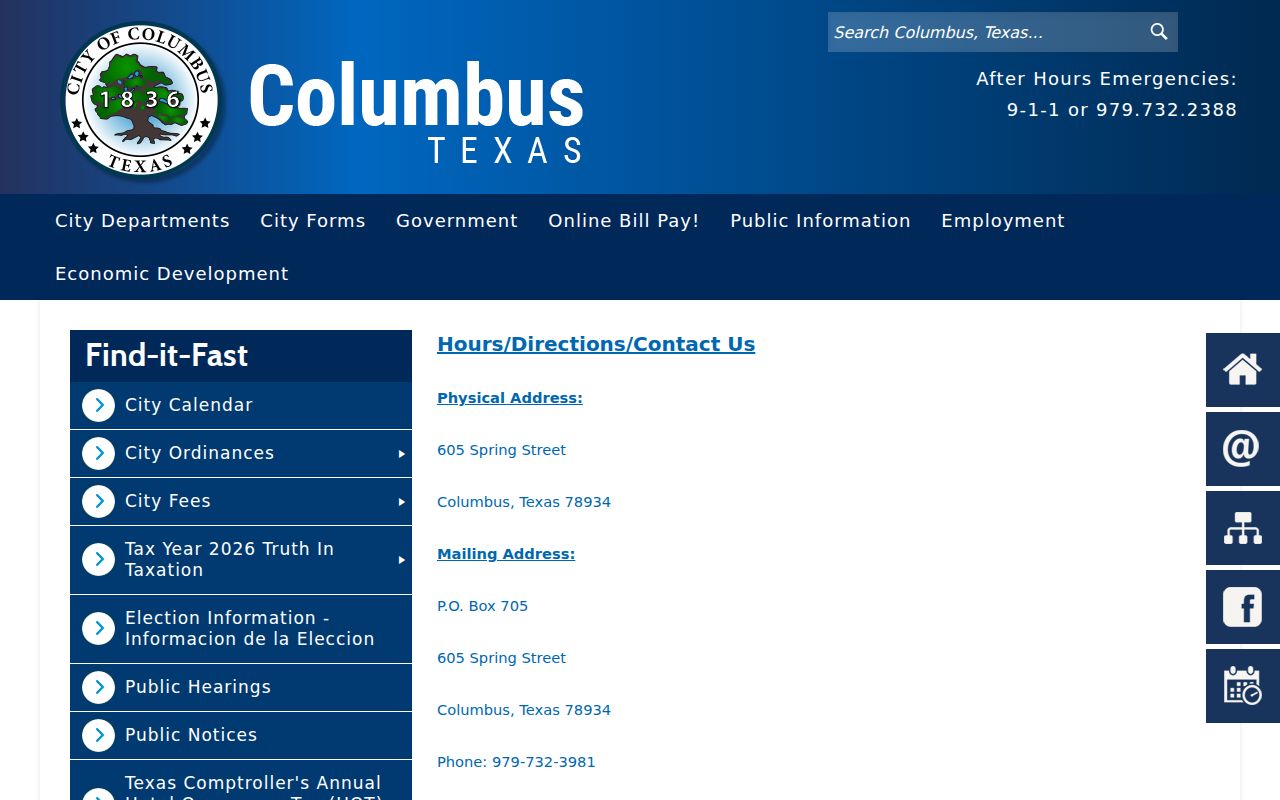
That view is a navigation aid, not the live record. Reopen the official source each time, because court dates, officers, forms, and instructions can change after the page was saved.